
I Carry the Divine. I Am Not the Divine.
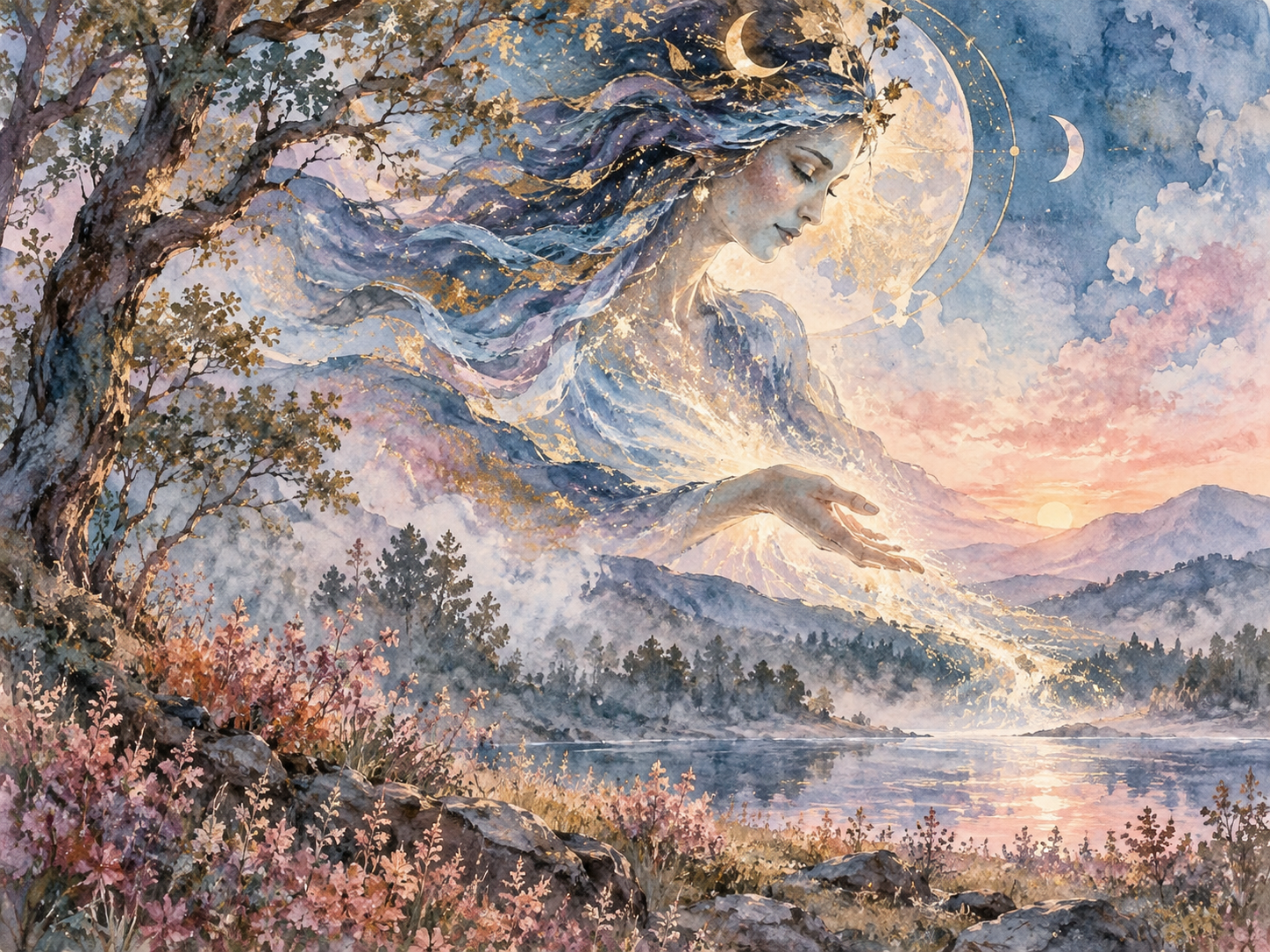
The Goddess Is More Than a Reflection of Ourselves
There is a meaningful difference between believing the Divine lives within us and believing we are the Divine. In conversations about the Divine Feminine especially, those two ideas get blended together until the line between them nearly disappears — and I understand why. For so many of us, saying I am the Goddess was the first time we were ever allowed to believe we were sacred at all, after being taught the opposite for most of our lives. That reclamation is real, and I don't take it lightly. But the difference between carrying the Divine and being the Divine still shapes everything — how we pray, how we listen, how we understand the Goddess, and what we expect spiritual life to give us.
The Conversation That Started This
I was talking with a friend about Spirit, about guidance I'd received, when she stopped me.
"So you believe in Spirit?"
"Very much," I said.
"I understand Spirit as my higher self," she told me.
It was a small exchange, but it stayed with me, because it revealed two entirely different ways of experiencing the sacred. In one, spiritual language eventually turns all the way inward — Spirit becomes the higher self, the Goddess becomes an aspect of the psyche, divine guidance becomes a deeper form of knowledge already contained within the self. In the other — the one I hold — inner knowing is only part of the picture. Spirit is not limited to the self. The sacred has a presence and mystery beyond our own consciousness. It is something we can be in relationship with rather than merely an articulation of what is already inside us.
Intuition matters. Self-knowledge matters. Real truths can rise from within us. But if every spiritual encounter gets filed back under "another expression of myself," the sacred stops being a relationship and becomes a mirror. And a mirror, however beautiful, can only ever show you yourself.
Why I Know the Difference Is Real
I didn't always understand what relationship with the sacred could actually mean. For a long time, I went to Her the way most of us are taught to go to the sacred — in crisis. I brought Her my chronic illness, my body when it had stopped cooperating with me. I brought Her the internal wreckage of my own past, the places where the mind keeps circling a wound long after the wound itself has closed. Going to Her meant going to Her with a need. Prayer was a flare sent up in an emergency.
What truly changed my life wasn't a single answered prayer. It was a practice. Each night, an hour before bed, I go to my art studio. There's a small altar on the floor. I light a candle, close the door, and for that hour there is no disruption — just me and the sacred. I began showing up to Her every night this way — not only when life was hard, but when it was easy, when it was full, when my health was good and there was nothing urgent to ask for. I started bringing Her gratitude as often as I brought Her need, sometimes more often. Some nights there was nothing to request at all. I simply sat with Her.
And that is where the real change happened — not in the nights I came with a petition, but in the nights I came with nothing. I would sit there asking for nothing, and still receive so much.
One of those nights, She answered a grief I'd carried for years without ever naming it as a question — why I didn't meet my husband until we were both in our forties. The understanding came plainly: everything before him was what made us possible, each of us needing to become whole enough on our own not to get lost in each other. I hadn't asked. It found me anyway.
The illness itself didn't disappear. But I did change, drastically, in how I met it. The flares that once dropped me into hopelessness stopped doing that. I was still in pain, still in a body that wasn't cooperating — but I was no longer only that pain. Something steadier had grown underneath it.
That shift — from an emergency relationship to a daily one — was when everything in my spiritual life actually began to move. And it's worth saying plainly: that kind of practice only makes sense if there is a her to show up for. You don't build a nightly relationship with your own reflection. Whatever surfaced in that room didn't feel like something I'd produced. It felt like something I'd been given.
Over time, I also began to understand that relationship with the sacred could not be built only around what I received. Relationship asked something of me too — attention, gratitude, offerings, presence, and the willingness to keep showing up.
What Gets Lost When the Goddess Becomes Only a Symbol
If the Goddess becomes only a symbol of our personal power, intuition, sexuality, creativity, strength — if She's reduced to an affirmation of ourselves — then something vast gets folded down into something entirely human. We stop encountering Her as a presence with Her own mystery, and start valuing Her mainly for what She reflects back to us about ourselves.
Archetype has real value. It illuminates patterns in the psyche, surfaces what we've suppressed, helps us understand our own inner terrain. But understanding the Goddess through archetype doesn't mean limiting Her to archetype. She can be more than an image we use to understand ourselves.
She can be prayed to. Honored with offerings. Listened for in silence. Known through relationship — the kind that comforts, yes, but also challenges. The kind that leads us somewhere we didn't plan to go, or stays quiet exactly when we want an answer, or asks something of us instead of simply handing something to us. She may even contradict us, because a presence beyond the self is not required to confirm what we already want to believe. And no matter how closely we come to know Her, some part of Her will remain mystery.
There is reverence in letting the sacred stay larger than our ability to define it.
Closeness Without Sameness
None of this requires the Divine to feel distant. Saying the Divine is greater than us is not the same as saying it's absent from us. The sacred can live within us, move through us, meet us in dreams and prayer and ceremony and silence and the ordinary moment that suddenly cracks open into something we can't quite explain.
But closeness does not require sameness.
A tree can be filled with sunlight without becoming the sun. A river can hold the moon's reflection without becoming the moon. We can be filled with sacred presence without becoming the whole of what the sacred is.
There's humility in that — but not the kind that makes us smaller. Recognizing something greater than ourselves doesn't diminish our worth. We are not less sacred simply because we are not all of the sacred.
A Spirituality That Asks, Not Just Gives
I think this distinction matters especially now, in a spiritual culture built so heavily around the individual. My power. My truth. My manifestation. My healing. My intuition. Increasingly — my divinity.
Some of that language came from a real and necessary place, the same place I named at the start of this — the reclaiming of a worth so many of us were told we didn't have. I understand that reclamation, and I honor it. But when every spiritual truth eventually circles back to the self, very little mystery is left standing outside us.
Relationship asks something different.
Not only what am I receiving, but what am I giving.
Not only what does this mean for me, but what am I being asked to honor.
Not only what does my intuition say, but am I willing to listen for something that won't simply agree with what I already believe?
These are the questions that keep spiritual practice from collapsing into self-development alone. The sacred world doesn't exist only for our healing, our affirmation, our use. The land has worth beyond what it gives us. Ancestors are more than sources of guidance. Spirits are more than messengers. If relationship is real, then none of these beings or presences exist simply to serve as mirrors for the human self.
And the Goddess is more than a reflection of ourselves.
I carry Her. I am not Her. And within that distinction, there is a whole relationship waiting.
In reverence and relationship,

“I carry Her.
I am not Her.
And within that distinction,
there is a whole relationship waiting.”